
What happens if rust is left untreated on a car?
If left untreated, car rust progresses from a minor cosmetic blemish to a severe structural safety risk that can lead to catastrophic vehicle failure. In the UK’s damp, salt-heavy climate, rust acts like a "cancer" for metal; once it takes hold, it spreads through chassis rails, sills, and suspension mounts, eventually making the vehicle unroadworthy and unsafe. Ignoring even minor surface spots can lead to resale value losses of £2,000–£5,000 and repair bills exceeding £3,000.
In this guide, we break down the stages of corrosion, the "iceberg" effect of hidden rust, and why in UK conditions, corrosion is not a question of if : but when.
The Three Stages of Untreated Corrosion
Rust doesn't happen overnight, but it is relentless. Understanding how it evolves is the first step in realising why early intervention is the only way to protect your investment.
1. Surface Rust
This is the early warning sign. It usually appears where paint has been chipped by road stones or where the factory's minimal underbody protection has worn away. At this stage, the rust is only on the very top layer of the metal. While it looks bad, the structural integrity of the steel remains intact. However, in the UK, surface rust can evolve into something much worse in just one winter season.
2. Scale Rust
If surface rust is ignored, the chemical reaction between iron, oxygen, and moisture (accelerated by road salt) penetrates deeper. The metal starts to flake away in layers, known as "scaling." This significantly weakens the component. If this happens on your chassis or suspension components, you are looking at a likely MOT failure.
3. Penetrating Rust
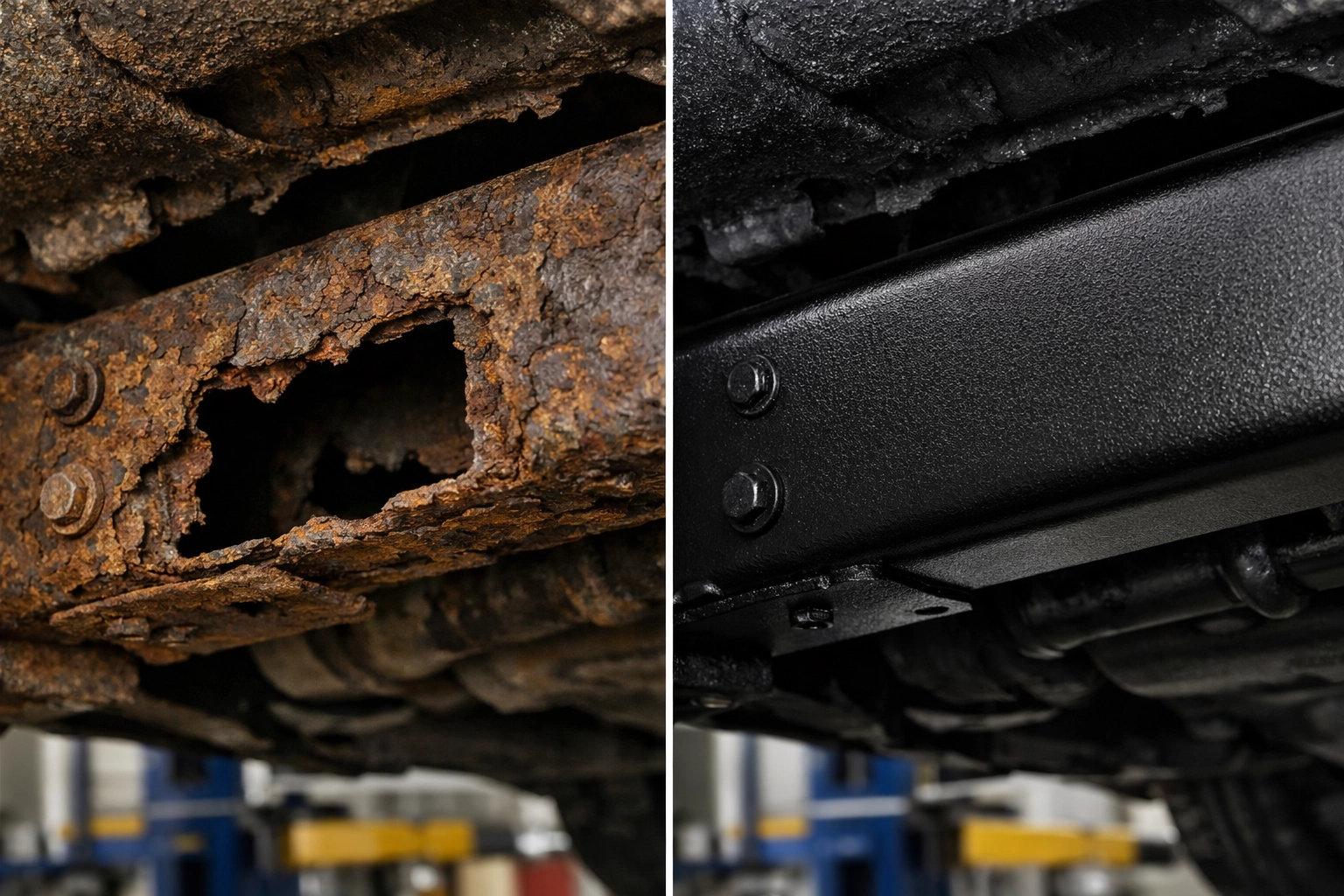
This is the final, most dangerous stage. The metal has been entirely consumed, leaving holes. This is particularly common in cavities like chassis rails and sills, where moisture gets trapped. Once rust has penetrated the metal, the only fix is to cut out the affected area and weld in new steel : a process that is both invasive and expensive.
The "Iceberg" Model: Why What You See Isn't the Whole Story
At Rustec, we often use the "Iceberg" analogy to explain vehicle corrosion to our customers.
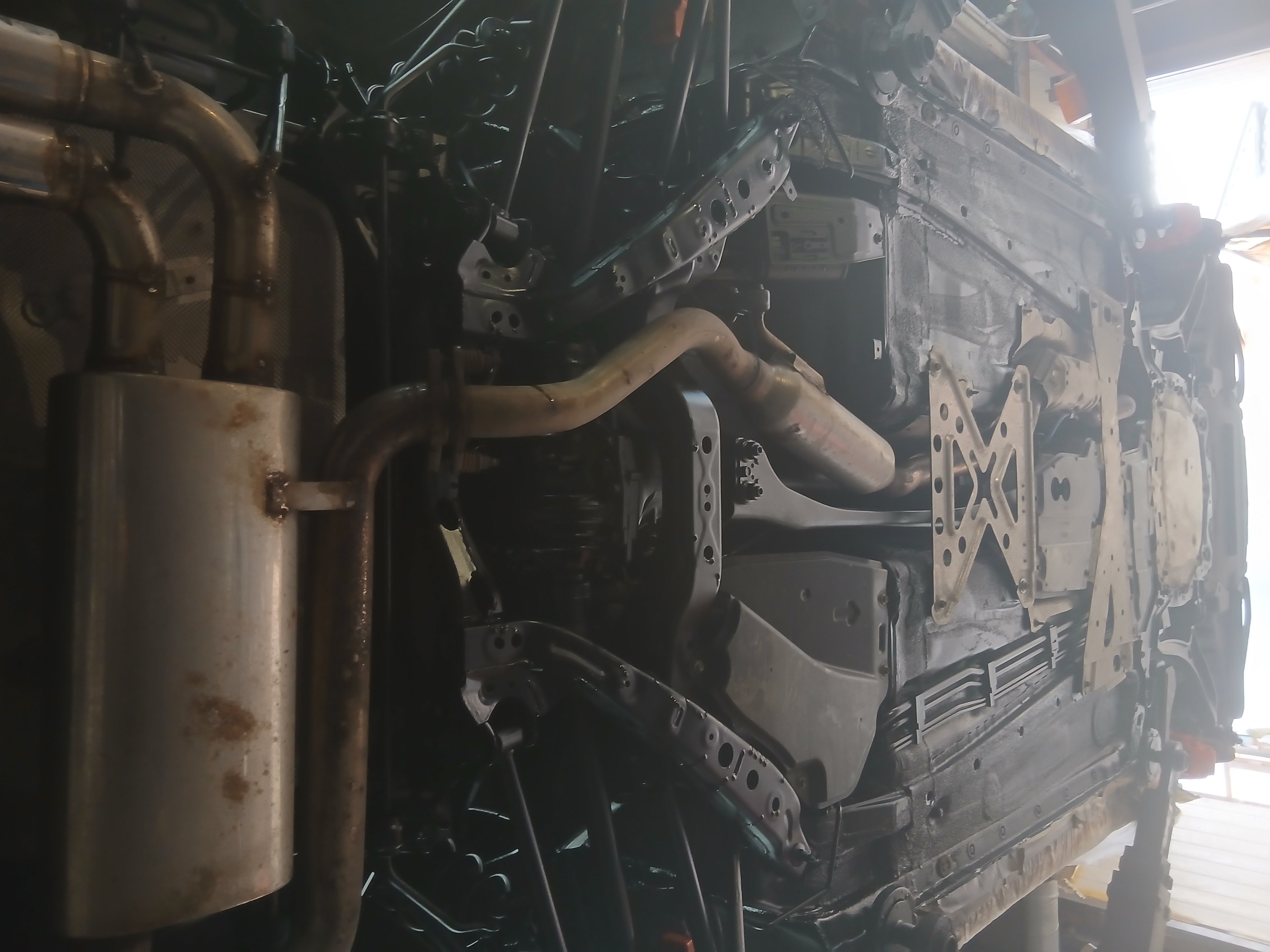
When you look at the underside of your car, you might only see 10% of the actual problem. The visible surface rust on a subframe or floor pan is just the tip. The real danger lies inside the hollow sections of the vehicle: the chassis rails, the door bottoms, and the sills.
Because these areas are enclosed, they trap mud, salt, and condensation. They stay wet for days after a rainstorm, allowing rust to eat the metal from the inside out. By the time you see a bubble of rust on the exterior paint of a sill, the internal structure is often already compromised. This is why cavity wax injection is a cornerstone of our professional process.
Financial Impact: Prevention vs. Cure
Delaying rust treatment is a choice to lose money. The financial logic for professional rustproofing is clear when you compare the costs:
Professional Treatment: A one-time investment in a high-quality service like the Rustec Elite Standard.
Welding Repairs: Structural welding for MOT failures typically costs between £1,000 and £3,000, depending on the extent of the damage.
Resale Loss: A vehicle with visible underbody corrosion or a history of structural welding is a red flag for buyers. This can result in a £2,000–£5,000 drop in resale value, especially for 4x4s, campervans, and classic cars.
Safety Risks and MOT Failure
It isn't just about money; it's about safety. Rust is a structural issue.
Brake and Fuel Lines: Rust doesn't just stick to the frame. It attacks the brake lines and fuel lines, which are often made of thin-walled steel. Corrosion here leads to fluid leaks and, in the worst cases, brake failure.
Suspension Mounts: If the areas where your suspension attaches to the chassis become "soft" due to rust, the vehicle's handling becomes unpredictable, and components can literally tear away from the body during an impact or heavy braking.
Crumple Zones: Cars are engineered to fold in specific ways during a crash to protect the occupants. Rust changes the way metal behaves under stress, meaning a rusty car is significantly less safe in an accident than a clean one.
A poor rustproofing job can be worse than doing nothing, as it traps moisture and accelerates corrosion. This is a warning we give to everyone considering "quick-fix" underseal services. If you spray a thick, bitumen-based coating over existing moisture and rust, you are effectively creating a "rust oven" that hides the damage while it gets worse.
Why the UK is the "Perfect Storm" for Rust
If you’ve wondered why cars rust faster in the UK than in other countries, the answer is a combination of high humidity and the aggressive use of road salt. In many parts of the world, it is either dry or the salt is washed away. In the UK, the "salt air" from our coastlines combined with the winter gritting creates a brine that clings to the underbody for months.
Even if you have a car that already has some rust, it is almost always possible to halt the progression if you act before it becomes structural.
The Solution: The Rustec Elite Standard (72-Hour Process)
We don't believe in "while-you-wait" undersealing. Proper protection requires a meticulous, multi-day commitment to quality. Our Elite Standard follows a strict 72-hour timeline to ensure your vehicle is protected for the long haul.
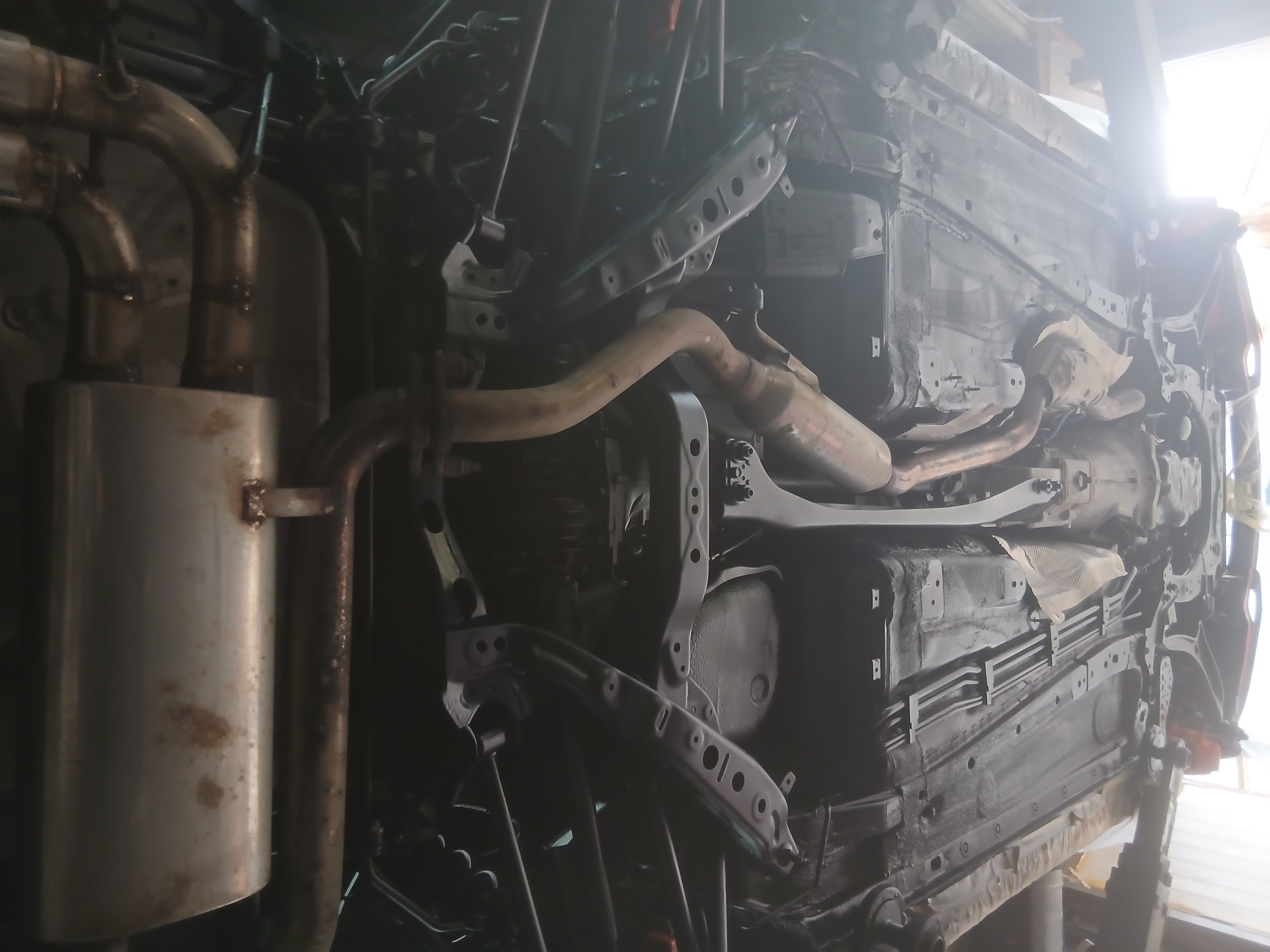
Day 01: Deep Clean & Strip Down: We perform a thorough undercarriage steam clean and remove all plastic undertrays and wheel arch liners to expose the hidden rust.
Day 02: Drying & Preparation: The vehicle is placed in a temperature-controlled environment to dry completely. We then meticulously mask up sensitive components like the exhaust, brakes, and electrical connectors.
Day 03: Treatment & Reassembly: We apply premium products, including high-penetration cavity waxes into all hollow sections and a durable, self-healing underbody coating to the exterior surfaces.
This process ensures that we aren't just "covering up" a problem, but actively preventing it. You can learn more about how this differs from basic services in our guide on how long professional rustproofing lasts.
FAQ: Untreated Car Rust
Is surface rust an MOT failure?
Surface rust is usually noted as an "advisory." However, if that rust is within 30cm of a structural mounting point (like suspension or seatbelt anchors) and has caused the metal to weaken or "holed," it will result in an immediate MOT failure.
Can I just spray over the rust myself?
You can, but it is risky. Without professional-grade cleaning and drying, you risk trapping moisture against the metal. Using the wrong products can also lead to the coating cracking and peeling, which actually speeds up the rusting process.
Is it worth rustproofing a car that already has rust?
Absolutely. Rustproofing is about stopping the "clock." While we can't turn rust back into solid steel, we can displace the oxygen and moisture required for the rust to continue spreading. It is far cheaper to stabilise existing rust than to wait for it to require welding.
How often should I check my car for rust?
We recommend a comprehensive inspection at least once a year, ideally after the winter season when road salt has done its worst.
Summary: Don't Wait for the Hole
Ignoring rust is a gamble where the stakes are your vehicle’s safety and its value. By the time rust becomes "obvious," the cost of repair has usually tripled. Moving from a problem-aware state to a solution-aware state means recognizing that a professional 72-hour treatment is the most cost-effective way to keep your car on the road for the next decade.
If you want to protect your vehicle properly : not just cover it up : the best time to act is before corrosion progresses. You can book a free inspection or request a quote here.
Comments