
Your Quick-Start Guide to Rustproofing Near Me: Do This Before Winter
Meta Title: Your Quick-Start Guide to Rustproofing Near Me: Do This Before Winter Meta Description: Don't wait for winter salt to destroy your chassis. Our guide explains why professional rustproofing is essential and how to book the best service near you. URL Slug: rustproofing-near-me-guide-before-winter
Professional rustproofing must be completed before the first gritting lorries hit the roads. To protect your vehicle effectively, you must choose a specialist who provides deep-chassis cleaning, thorough drying, and a combination of internal cavity waxes and external underbody barriers. Searching for "rustproofing near me" is the first step, but the quality of the process, specifically a multi-day treatment, determines whether your car survives the winter or becomes a financial liability.
The Visual Mental Model: The Waterproof Boot
Proper rustproofing is like applying high-quality waterproofing treatment to a pair of premium leather boots before walking into a marsh. If you wait until your feet are already wet and the leather is soaked, the treatment is a failed strategy. Applying a barrier over moisture or salt only seals the destruction inside. To be effective, the "boot" (your chassis) must be bone-dry and surgically clean before the protective layer is applied.
Ownership Identity: Why the Elite Act Early
There are two types of vehicle owners in the UK: those who view their vehicle as a disposable appliance and those who view it as a long-term asset. Long-term owners, collectors, 4x4 enthusiasts, and savvy commuters, understand that they do not own the vehicle’s bodywork; they own the chassis.
Preserving vehicles early avoids expensive surprises later. These owners do not wait for a "pass with architectural advice" on an MOT certificate. They intervene when the metal is still structural and healthy. By the time most people think to look for rustproofing, the "inevitability" of UK corrosion has already taken hold. Elite owners protect the chassis early to avoid expensive repairs and ensure their vehicle remains safe and high-value for a decade or more.
UK-Specific Context: The Perfect Storm for Corrosion
The UK climate is uniquely hostile to automotive steel. We suffer from high humidity, frequent rainfall, and a heavy reliance on road salt (sodium chloride) and liquid de-icers. When salt mixes with water, it creates an electrolytic solution that accelerates the electrochemical reaction known as rusting.
Furthermore, many modern vehicles feature plastic undertrays. While these improve aerodynamics, they act as "salt traps," holding wet, salty grit directly against the steel frame rails. In UK conditions, corrosion is not a possibility , it is an inevitability without proper protection. If you live near the coast or in northern regions where gritting is more frequent, the rate of decay doubles.
Financial Consequence: The Cost of Delay
Doing nothing leads to financial loss. There is no middle ground. If you ignore your underbody, you are choosing to pay later in one of three ways:
Welding and Structural Repairs: Once rust takes hold of sills, suspension mounts, or frame rails, you are looking at costs between £1,000 and £4,000+.
Resale Value Loss: A vehicle with a "clean" MOT history and a documented professional rustproofing treatment commands a premium. Conversely, visible surface corrosion can lead to a £2,000 to £5,000 drop in resale value.
Premature Replacement: If the chassis fails, the car is often written off, forcing you into a new vehicle purchase years earlier than planned.
In contrast, the cost of rustproofing in the UK typically ranges from £500 to £1,200, depending on the vehicle size and condition. This is a fractional investment compared to the thousands lost to neglect.
WHEN TO ACT: The Window of Opportunity
Timing is everything. Once rust is visible to the naked eye, the metal has already begun to thin.
0–3 Years (Prevention): The ideal window. Protecting a factory-clean chassis ensures it stays that way.
3–5 Years (Ideal): Most vehicles start showing "bloom" or surface rust. This is the last chance to stop it before it becomes structural.
5+ Years (Urgent): If you haven't treated the vehicle, it is likely already corroding in the cavities.
Visible Rust (Time-Sensitive): You are no longer preventing; you are managing a crisis.
The biggest mistake is waiting until rust becomes visible. By then, you are paying for cure rather than prevention.
Comparison: Rustec Elite vs. Quick-Spray Services
Not all rustproofing is equal. You will find local garages offering a "spray over" service for a few hundred pounds. A poor rustproofing job can be worse than doing nothing, as it traps moisture and accelerates corrosion.
Feature | Quick "Drive-In" Service | Rustec Elite 72-Hour Standard |
Duration | 2–4 hours | 72 hours (minimum) |
Preparation | Surface wipe / Power wash | Industrial steam clean & 24h dry |
Masking | Minimal or none | Full masking of brakes, exhaust, sensors |
Cavity Work | Often ignored | Full internal injection (sills, doors, rails) |
Durability | 6–12 months | Multi-year protection |
Most quick services focus on speed and appearance. We focus on preparation, internal protection, and long-term structural preservation.

The Rustec Elite 72-Hour Standard
Process matters more than product. Even the best rustproofing method for UK vehicles will fail if the application is rushed. At Rustec, we follow a rigorous four-stage protocol:
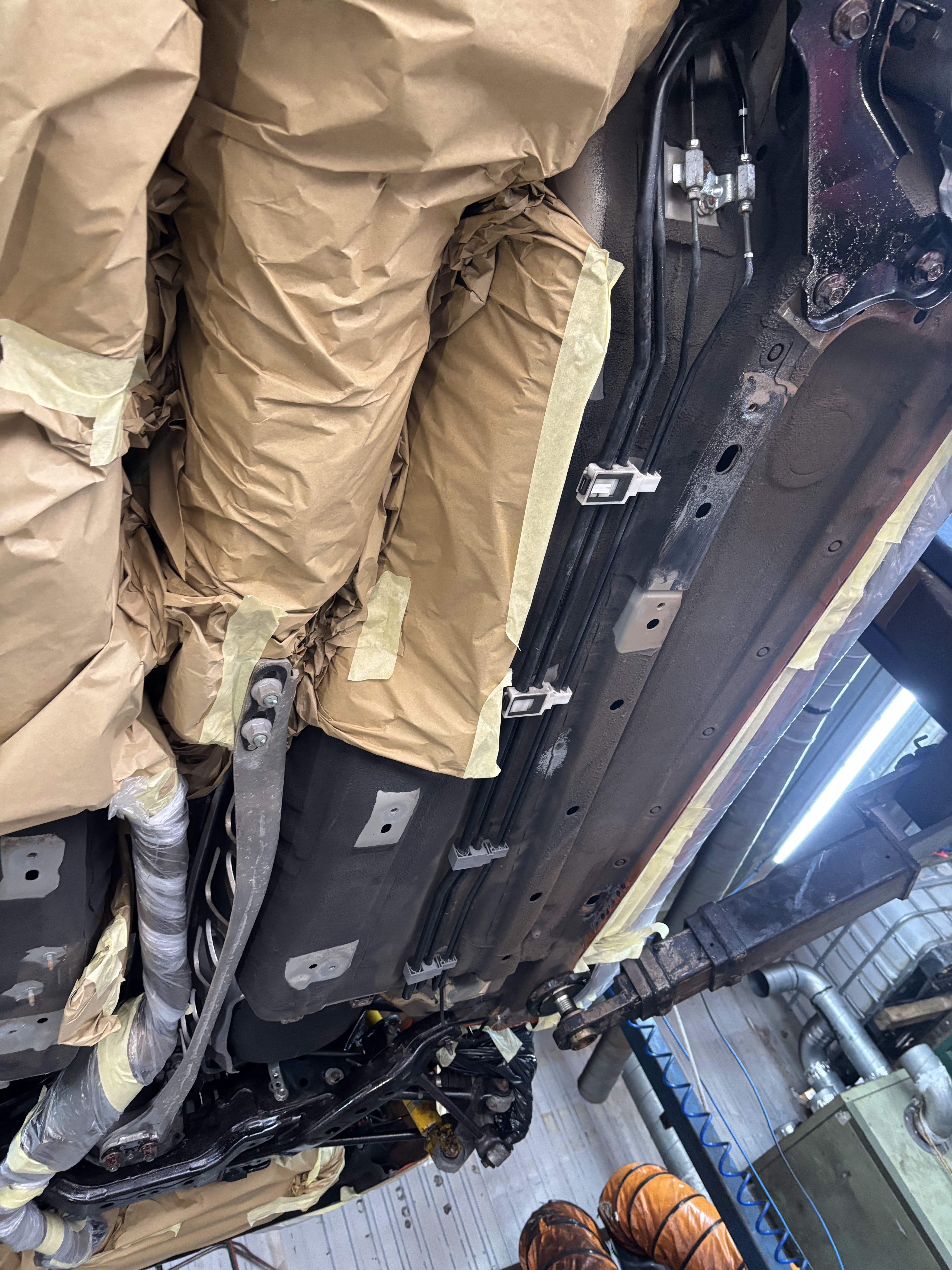
Deep Clean: We remove all plastic undertrays and wheel arch liners. The chassis is subjected to a high-pressure hot water wash to remove every grain of salt and road grime.
Extended Drying: Applying product to a damp chassis is negligence. We use industrial heaters and air movers to ensure the metal is perfectly dry, even inside the box sections.
Precision Masking: We meticulously mask the exhaust system, brake discs, sensors, and moving suspension components. We do not "black out" your underside indiscriminately.
The Treatment: We apply high-grade cavity waxes into every hollow section of the vehicle. Only then do we apply the external underbody barrier to the exposed metal surfaces.
Buyer Psychology: Avoiding the "Regret Trigger"
"I wish I did this sooner." This is the most common phrase we hear from owners of five-year-old vehicles. They see the beginning of a can rust cause MOT failure warning and realise they could have spent £700 three years ago to save £2,000 today.
Rustproofing is about peace of mind. It is about knowing that when you drive through a flooded, salted road in January, your vehicle's structural integrity is not being compromised. Understand that does rustproofing increase resale value isn't just a theory, it's a fact reflected in the used car market for Defenders, Hiluxes, and classic cars.

What Should You Do Next?
If you are planning to keep your vehicle for more than two years, the time to act is now. While the weather is still mild, booking your slot ensures the preparation is optimal. Do not wait for the winter rush when every specialist is fully booked and the roads are already white with salt.
Inspect: Look at your wheel arches and the rear subframe. If you see brown staining, it's already started.
Verify: Ask your local provider about their drying process. If they don't mention a 24-hour dry time, go elsewhere.
Invest: Understand how long rustproofing lasts in the UK depends entirely on the initial prep.
FAQ: Common Rustproofing Questions
Q: Can you rustproof a car that already has surface rust? A: Yes, but the process changes. We must use specific "creeping" waxes that penetrate the rust layer and displace oxygen, which stops the oxidation process. Heavily flaking rust may need mechanical removal first.
Q: Will rustproofing void my manufacturer's warranty? A: No. In fact, professional rustproofing supplements the often-inadequate factory protection. We do not drill holes in your vehicle; we use existing access points.
Q: How often does it need to be redone? A: A high-quality treatment using the Rustec Elite Standard typically requires a minor "touch-up" inspection every 2–3 years, but the core protection lasts significantly longer.
Q: Can I do this myself with a spray can? A: You can apply a temporary barrier, but without a vehicle lift, industrial cleaners, and proper cavity injection probes, you will miss 70% of the vulnerable areas. DIY often leads to trapping moisture behind the coating.
Rust doesn’t wait until it becomes visible. By the time most owners notice a problem, the damage underneath has already started costing them money. Waiting feels cheaper in the short term : but it nearly always becomes more expensive later.
👉 Book your inspection now [https://calendly.com/rustec-works/free-vehicle-inspectioni] and protect your vehicle before corrosion takes hold.
Link to 3 existing relevant Rustec blog posts:
Comments