
The Risk of Leaving It Too Late: When Your Car Becomes Economically Unviable
A vehicle becomes economically unviable when the cost of structural rust repairs and the associated loss in resale value exceed the logical investment threshold of the owner. In the UK, the biggest mistake is waiting until rust becomes visible. Once corrosion is seen on the outer sills or wheel arches, the internal structure is often already compromised. Delaying professional treatment turns a manageable prevention cost into a four-figure welding bill or, eventually, a crushed car.
The Missed Flight: Why Timing is Everything
Think of vehicle preservation like catching a long-haul flight. If you arrive at the gate ten minutes after it closes, it does not matter how much you are willing to pay for a ticket; the plane is gone. Structural rust works on the same binary principle.
There is a definitive window where the metal is still "saveable" through high-grade chemical conversion and encapsulation. Once that window closes, once the rust has perforated the chassis or thinned the steel beyond MOT safety standards, you have missed the flight. You are no longer looking at rustproofing; you are looking at surgery. Restoration is exponentially more expensive than preservation. Doing nothing leads to financial loss, and in the UK, that loss is often total.
The UK Environment: A Catalyst for Rapid Decay
The UK is one of the most hostile environments in the world for automotive steel. It is not just the rain; it is the combination of high humidity, consistent moisture, and the aggressive use of sodium chloride (road salt) during the winter months.
Salt is hygroscopic, meaning it attracts and holds moisture against the metal. When this salty brine enters your vehicle’s box sections and chassis rails, it creates an electrolyte that facilitates rapid galvanic corrosion. Because the UK rarely sees prolonged dry periods, your car’s underbody stays damp for months at a time. This constant state of oxidation means that In UK conditions, corrosion is not a question of if — but when.
The Financial Reality: Prevention vs. Catastrophic Loss
Owners often hesitate at the cost of rustproofing in the UK, viewing it as an optional expense. This is a fundamental misunderstanding of automotive depreciation. To understand the risk of leaving it too late, you must compare the numbers:
Professional Prevention: Typically costs between £500 and £1,200 depending on vehicle size and condition.
Welding Repairs: Patching a structural chassis or floor pan for an MOT often starts at £1,000 and can easily exceed £4,000 for complex areas like rear subframe mounts or inner sills.
Resale Value Loss: A vehicle with a "clean" underside commands a premium. A vehicle with "corrosion" listed as an MOT advisory or visible surface rot will suffer a £2,000 to £5,000 hit to its market value.
When you add the cost of professional welding to the massive drop in resale value, the vehicle quickly becomes a liability rather than an asset. At this point, it is economically unviable.
The Iceberg Model: What You See Isn’t the Whole Story
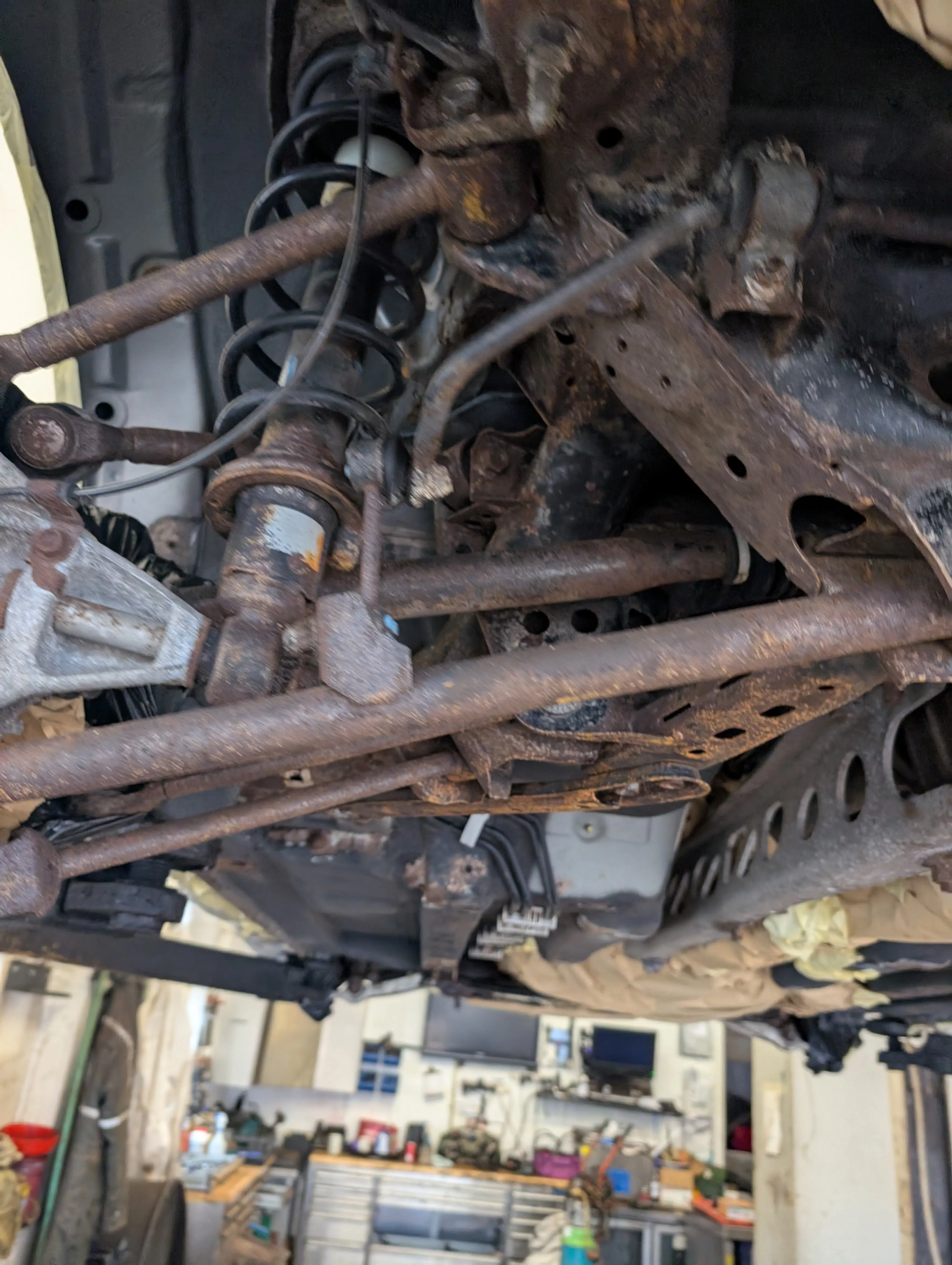
Corrosion is an "iceberg" problem. The visible rust on a wheel arch or a door bottom represents only about 10% of the total oxidation occurring on the vehicle. The real damage happens from the inside out.
Rust begins in the hollow cavities, the sills, the chassis rails, the pillars, and the box sections. These areas trap condensation and road salt but have no airflow to dry out. By the time you see a bubble in the paintwork, the metal underneath has likely been thinned by 50% or more. This is why "waiting for a sign" is the worst strategy an owner can take.
WHEN TO ACT: Your Window of Opportunity
The clock starts ticking the moment a vehicle leaves the showroom. Factory protection is minimal, designed to last just long enough to outrun the manufacturer's perforation warranty.
0–3 Years (The Prevention Window): This is the gold standard. Treating a vehicle in this window stops corrosion before it starts. It preserves the factory finish and ensures the highest possible resale value.
3–5 Years (The Ideal Window): Most UK vehicles will have light surface tea-staining by this point. Treatment is highly effective but requires more intensive preparation.
5+ Years (The Urgent Window): Corrosion is likely established in the cavities. Delaying any further risks the vehicle failing an MOT or requiring structural welding.
Visible Perforation (Too Late): If the metal has holes, you are beyond the scope of rustproofing. You must weld first, then protect.
Professional Standard vs. The "Quick Spray" Trap
When owners realise they have left it late, they often panic and opt for a "quick underseal" at a local garage. This is a fatal error. A poor rustproofing job can be worse than doing nothing, as it traps moisture and accelerates corrosion.
Cheap services sell speed. Proper rustproofing demands preparation. That is the real competitor contrast. One approach is built around getting a vehicle in and out in a few hours. The other is built around cleaning, drying, masking, cavity access, and controlled application so the protection has a chance of lasting. Process matters more than product.
Cheap services often involve spraying a thick, bitumen-based coating over existing dirt, grease, and moisture. This creates a "pocket" where the rust can eat away at the chassis in a warm, damp, anaerobic environment, hidden from view until the component fails structurally. The speed-first model is the problem. Prep determines longevity.
Feature | Cheap "Quick" Job | Rustec Elite Standard |
Duration | 3–5 Hours | 72 Hours |
Preparation | Surface brush only | Deep steam clean, dry, inspect |
Drying Time | None | Forced heat drying |
Cavity Work | Minimal or none | Full internal injection |
Masking | None (overspray risk) | Comprehensive |
Priority | Speed and turnover | Preparation and full coverage |
Risk | High (traps moisture) | Low-risk professional process |
The Rustec Elite Standard: A 72-Hour Scientific Process
To save a vehicle that is approaching the "unviable" threshold, you cannot cut corners. At Rustec, we follow a meticulous 72-hour Elite Standard process that explains how long rustproofing lasts in the UK.
Stage 1: Decontamination: We remove all underbody plastics and heat shields to expose the hidden steel. We then perform a high-pressure hot water wash to remove all road salt and grease.
Stage 2: Forced Drying: We use industrial heaters to ensure the chassis is 100% dry. Applying any product to damp steel is a recipe for failure.
Stage 3: Meticulous Masking: We mask the exhaust, brakes, and electrical sensors. We treat your vehicle like a precision machine, not a piece of farm equipment.
Stage 4: Cavity Injection: We inject high-penetration waxes into every box section and pillar to stop "inside-out" corrosion.
Stage 5: External Encapsulation: We apply a durable, self-healing underbody coating that provides a physical barrier against salt and stones.

Ownership Identity: Protect It Like an Owner, Not a Temporary User
Serious owners think in decades, not MOT cycles. They protect the asset before corrosion forces a decision. If you intend to keep the vehicle, maintain its underside, preserve its structure, and defend its future value. If you plan to sell it later, the logic is the same. A clean, well-preserved underbody supports buyer confidence and strengthens does rustproofing increase resale value.
This is the difference between reactive ownership and long-term ownership. Reactive owners wait for advisories, bubbling paint, or a failed inspection. Long-term owners deal with the problem before it becomes visible. That is why the best rustproofing method for UK vehicles is the method built around timing, preparation, cavity protection, and repeat inspection, not speed.
Regret Minimisation: Why Owners Wait Too Long
Every month we see owners who bring us vehicles that are six months too late. The phrase we hear most often is: "I wish I’d done this two years ago."
The psychological trap is thinking that because the car looks fine today, it will be fine tomorrow. But the corrosion is silent and invisible. By acting now, you are not just buying a "coating"; you are buying an insurance policy against the £3,000 welding bill waiting for you in 24 months. You are protecting future saleability, reducing the chance that can rust cause MOT failure, and reinforcing does rustproofing increase resale value when you eventually decide to sell.
If you are serious about your vehicle, stop looking at the surface and start looking at the schedule. Review the cost of rustproofing in the UK, compare it with welding and resale loss, and act before the numbers turn against you.
In UK conditions, corrosion is not a question of if — but when. Delaying turns prevention into welding bills, MOT risk, and resale loss. Rust does not wait. Book your inspection now: https://calendly.com/rustec-works/free-vehicle-inspectioni
FAQ: High-Intent Buyer Questions
Is it worth rustproofing an older car? Yes, provided the car is still structurally sound. If the chassis is solid, professional treatment can arrest existing surface rust and prevent it from becoming a terminal structural issue. We assess every vehicle to ensure it is still a viable candidate for treatment.
How often does the treatment need to be reapplied? While our Rustec Elite Standard is designed for long-term durability, we recommend a minor inspection and "touch-up" every 2–3 years to account for mechanical damage or extreme off-road use.
Will rustproofing affect my manufacturer warranty? Generally, no. In fact, most manufacturers' corrosion warranties are extremely limited and only cover "perforation from the inside out," which is notoriously difficult to claim on. Professional rustproofing provides the protection the manufacturer failed to include.
Can rust cause MOT failure? Yes. If corrosion affects a prescribed area near suspension, steering, braking mounts, seat belt anchor points, or other structural sections, it can trigger an MOT failure. That is why early prevention matters.
Can I do this myself with a DIY kit? You can, but without a vehicle lift, industrial steam cleaners, and high-pressure injection equipment, you cannot achieve full coverage. Most DIY jobs fail because the owner cannot properly clean or dry the chassis, leading to the "trapped moisture" problem.
Related Rustec posts
Comments