
What Does Rustproofing Protect? A Deep Dive into Structural Preservation
Professional rustproofing protects the structural integrity of your vehicle by shielding the chassis, sills, suspension mounts, and brake lines from oxidation. It is a comprehensive preservation process that targets the "skeleton" of the car, the parts that keep you safe in a collision and ensure your vehicle passes its annual MOT. While many owners focus on the gleaming paintwork, the real battle against corrosion happens underneath, where road salt, humidity, and trapped debris combine to destroy metal components from the inside out.
In this deep dive, we look at exactly what is being protected when you book a professional treatment, why specific components are high-priority, and how the Rustec Elite Standard ensures these areas remain preserved for the long term.
The Visual Mental Model: The Skeleton and the Skin
Think of your vehicle like a human body. The paintwork and panels are the "skin", they look good and provide the first line of defence. However, the chassis and subframes are the "skeleton." If a person has strong skin but brittle, crumbling bones, they lack structural integrity.
Proper rustproofing is like providing a permanent, flexible suit of armour for the skeleton. It doesn't just "paint" the metal; it seals it. In UK conditions, corrosion is not a question of if , but when. Without this structural preservation, the very foundation of your vehicle will eventually succumb to the elements.
01: The Chassis and Main Rails (The Backbone)
The chassis is the most critical component protected by rustproofing. Whether you have a ladder-frame chassis (common on 4x4s like Defenders or Hiluxes) or a modern unibody construction, this is the structural heart of the car.
When searching for "car undercoating near me," it is vital to understand that the exterior of the chassis is only half the story. Corrosion often starts inside the box sections where moisture becomes trapped. Professional treatment involves injecting high-viscosity cavity waxes (like Dinitrol® ML) into these internal voids.
What is protected: Main longitudinal rails, cross-members, and body mounts.
The Risk: A rotted chassis rail is often an automatic MOT failure and can cost between £1,500 and £3,500 to repair properly with structural welding.
02: Sills and Box Sections (The MOT Failure Zones)
Sills are notorious for "iceberg" rust. Because they are hollow, they collect condensation and road spray. By the time you see a bubble of rust on the exterior paint of a sill, the internal structure is usually already heavily compromised.
Professional rustproofing protects these areas by sealing the internal metal surfaces. This prevents the "inside-out" rot that plagues so many UK vehicles. Protecting these areas is essential for maintaining the vehicle's resale value and ensuring it remains structurally sound during its lifetime.
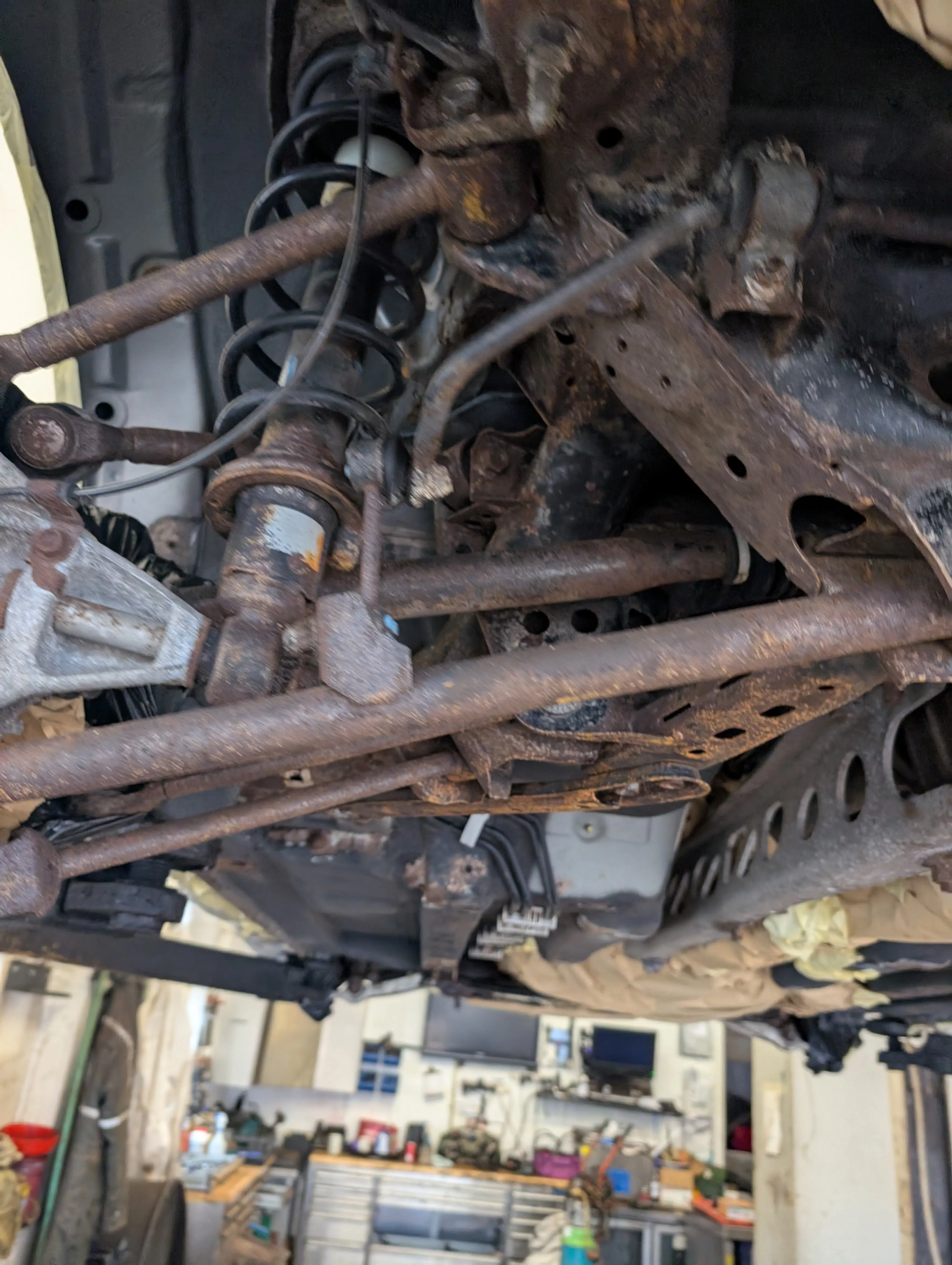
03: Suspension Mounts and Subframes
Your suspension components are under constant stress. Rustproofing these areas protects the mounting points where the suspension attaches to the body. If these points weaken, the handling of the vehicle becomes unpredictable, and in extreme cases, the suspension can actually tear away from the mounting.
Suspension Arms: Often made of heavy-gauge steel that can flake and thin over time.
Coil Spring Seats: Areas where debris sits and traps moisture against the metal.
Subframes: Often ignored by "cheap" spray jobs, these are critical for engine and drivetrain alignment.
04: Brake and Fuel Lines
One of the most overlooked benefits of professional "car undersealing near me" is the protection of hard lines. Steel brake lines and fuel pipes are highly susceptible to corrosion.
Replacing a full set of corroded brake lines can cost upwards of £500 to £800 in labour alone, as it often requires dropping subframes or fuel tanks to gain access. By masking these areas meticulously and applying the correct grade of protection, we ensure these life-critical components remain in "as-new" condition.
The Iceberg Model of Hidden Rust
Most vehicle owners only worry about rust when they can see it. However, rust is like an iceberg, 90% of the danger is hidden beneath the surface.
Surface Rust: Visible, but usually superficial.
Structural Thinning: Occurs inside box sections and behind plastic liners.
Perforation: When the rust finally "breaks through" to the surface.
By the time you reach step 3, the structural integrity of the metal is gone. This is why our process focuses so heavily on cavity injection. A poor rustproofing job can be worse than doing nothing, as it traps moisture and accelerates corrosion.

The Rustec Elite Standard: A 72-Hour Clinical Process
We do not believe in the "spray and go" approach. To truly protect the components mentioned above, a rigorous process is required. We call this the Rustec Elite Standard.
Step 01: Deep Clean & Decontamination: A thorough undercarriage steam clean to remove all salt, grease, and road grime.
Step 02: Extended Drying: The vehicle is placed in a temperature-controlled environment for 24 hours. Applying product to damp metal is a recipe for disaster.
Step 03: Meticulous Masking: We mask the exhaust, heat shields, brake discs, and sensors to ensure the product only goes where it belongs.
Step 04: Cavity Injection: Specialized wands inject Dinitrol® wax into the sills, chassis, and pillars.
Step 05: Underbody Coating: A durable, flexible premium underseal is applied to all exposed metal surfaces.
Comparison: Professional Preservation vs. "Cheap" Undersealing
Feature | Cheap "Quick" Job | Rustec Elite Standard |
Preparation Time | 1–2 Hours | 24–48 Hours (Cleaning/Drying) |
Cavity Injection | Rarely included | Full internal injection |
Masking | Minimal or none | Comprehensive masking of all non-target parts |
Product Quality | Generic "bitumen" paint | Long-life Dinitrol® system |
Documentation | None | Full photo documentation & Service Booklet |
Longevity | 6–12 months | Years of protection |
The Financial Justification: Why Prevention Wins
Investing in professional rustproofing is a matter of simple mathematics.
Cost of Rustec Treatment: Typically £600–£1,200 (depending on vehicle size).
Cost of Structural Welding: £1,000–£3,000.
Loss in Resale Value: A "rusty" vehicle can lose 20-30% of its market value compared to a "chassis-preserved" example.
Replacement Cost: If a vehicle fails an MOT on structural corrosion and is deemed "beyond economical repair," the loss is the entire value of the car.
For a one-off investment, you are effectively "freezing" the condition of your vehicle’s underside. This is particularly vital for classic cars, motorhomes, and high-value 4x4s.

UK Context: Why Our Climate Demands It
The UK has a perfect storm for vehicle corrosion. We have high humidity, consistent rainfall, and, crucially, thousands of tonnes of road salt spread every winter. This salt forms a corrosive brine that sticks to the metal of your chassis. If you live near the coast, salt-laden air adds another layer of risk.
As discussed in our previous post on the cost of waiting to rustproof, the longer you leave your vehicle unprotected, the more "pre-treatment" is required to stop existing oxidation before the protective layers can be applied.
FAQs: What Does Rustproofing Protect?
Does rustproofing protect the exhaust? No. Exhaust systems operate at extremely high temperatures that would melt or burn off rustproofing waxes. We mask the exhaust to prevent unpleasant smells and smoke. However, protecting the mounts that hold the exhaust is part of the service.
Will it protect my car from MOT failure? Yes. The most common structural MOT failures are related to corrosion within 30cm of a mounting point (suspension, seatbelts, etc.) or "excessive corrosion" of the chassis. Professional treatment keeps these areas in a condition that exceeds MOT requirements.
Is it worth protecting a brand-new car? Absolutely. As we noted in our guide to modern factory protection, manufacturers often provide the bare minimum. Treating a car while it is "clean" is the most effective way to ensure it stays that way for its entire life.
Can you rustproof over existing rust? We can, but it requires a specific process. We use Dinitrol® ML, which is designed to penetrate through surface rust and soak into the metal pores, displacing moisture and stopping the oxygen from reaching the metal. We do not just "cover up" rust; we treat it.
Final Takeaway: Protect Your Investment
Rustproofing is not an aesthetic choice; it is a structural necessity for anyone planning to keep their vehicle for more than a few years in the UK. By protecting the chassis, sills, and safety-critical components, you are ensuring your pride and joy remains safe, legal, and valuable.
If you want to protect your vehicle properly : not just cover it up : the best time to act is before corrosion progresses. You can book a free inspection or request a quote here.
Comments