
Early Rust Is Easy to Stop: Why Timing Is Everything
- Lloyd Saunders
- Apr 23
- 5 min read
Catching rust in its early stages is the single most effective way to preserve your vehicle's value and structural integrity. In the UK, where road salt and high humidity are constant threats, addressing surface corrosion before it penetrates the metal is the difference between a straightforward preservation treatment and thousands of pounds in structural welding. The "golden window" for most modern vehicles occurs between three and five years of age, just as factory protection begins to fail but before the first major MOT advisory for corrosion appears.
The Financial Reality: Prevention vs. Repair
When it comes to vehicle maintenance, the math is simple: prevention is a controlled investment, while repair is an emergency expense. If you act while rust is still at the "surface" stage, usually visible as light orange staining on subframes or suspension components, the process involves cleaning, treating, and sealing.
However, if you wait until the rust becomes structural, the costs escalate exponentially. In the UK, it is common for owners of five-to-ten-year-old vehicles to face welding quotes ranging from £1,000 to £3,000 just to pass an MOT. Furthermore, a vehicle with a history of corrosion advisories can suffer a £2,000 to £5,000 hit to its resale value. In UK conditions, corrosion is not a question of if , but when. By investing in professional rustproofing early, you are not just buying a coating; you are protecting your largest depreciating asset from becoming a liability.
Visual Mental Model: The Dental Hygiene Analogy
Think of rustproofing like dental hygiene. A professional clean and the occasional filling (prevention and early treatment) is relatively quick and affordable. Neglecting your teeth until they ache leads to root canals and extractions (structural welding and parts replacement), processes that are significantly more painful, expensive, and involve losing the original material forever.
The 'MOT Golden Window'
Most modern cars leave the factory with a "good enough" level of protection designed to last the duration of a standard three-year lease or warranty period. Once a vehicle hits its first MOT at three years old, the clock starts ticking faster. This is what we call the "Golden Window."
During years three to five, the underbody has been exposed to roughly 150-200 days of wet weather and at least three winters of heavy road salting. The factory PVC underseal often begins to micro-crack or delaminate at the edges. Because the metal underneath is still structurally sound, this is the easiest and most effective time to apply a high-quality Dinitrol® treatment. Catching it here means the rust-inhibiting waxes can penetrate the early oxidation and "freeze" it in place, preventing the transition to "pitting" or "scaling."

Surface Spots vs. Structural Failure: The Slippery Slope
Rust doesn't sleep, and it doesn't stay on the surface. What starts as a small "bloom" on a suspension arm or a chassis rail is actually an electrochemical reaction that is eating the iron within the steel.
We often refer to this as the "Iceberg Model" of corrosion. The rust you see on the outside is usually only 10% of the problem. The real damage happens inside the chassis rails, sills, and pillars, areas where moisture and salt become trapped and sit in a stagnant, humid environment. By the time rust is visible as a hole or a "flake" on the exterior, the internal structure is often already compromised.
A poor rustproofing job can be worse than doing nothing, as it traps moisture and accelerates corrosion. This is why simply spraying a "cheap and quick" bitumen coating over existing rust is a recipe for disaster; it hides the rot while providing it with the perfect dark, damp environment to accelerate.
The Rustec Elite Standard: A Clinical Approach
At Rustec, we don't just "underseal" cars; we provide a clinical preservation service. We believe that the process is far more important than the product itself. Our Rustec Elite Standard is a meticulous 72-hour process designed to ensure that the protection actually works.
01: Comprehensive Inspection & Strip Down
We begin by removing all plastic undertrays, wheel arch liners, and heat shields. You cannot protect what you cannot see. We inspect the entire underbody to identify the exact stage of corrosion.
02: Thorough Undercarriage Steam Clean
Using high-pressure hot water, we remove all road salt, grease, and debris. This is critical because applying treatment over salt is simply sealing in the "engine" of rust.
03: Drying & De-rusting
The vehicle is dried thoroughly using industrial heaters. Any loose surface rust is mechanically removed to ensure the chemical converters and waxes have a solid surface to bond to.
04: Meticulous Masking
This is where our "clinical workshop vibes" really show. We spend hours masking off the exhaust system, brake discs, engine components, and the vehicle's bodywork. A professional job should never have overspray.
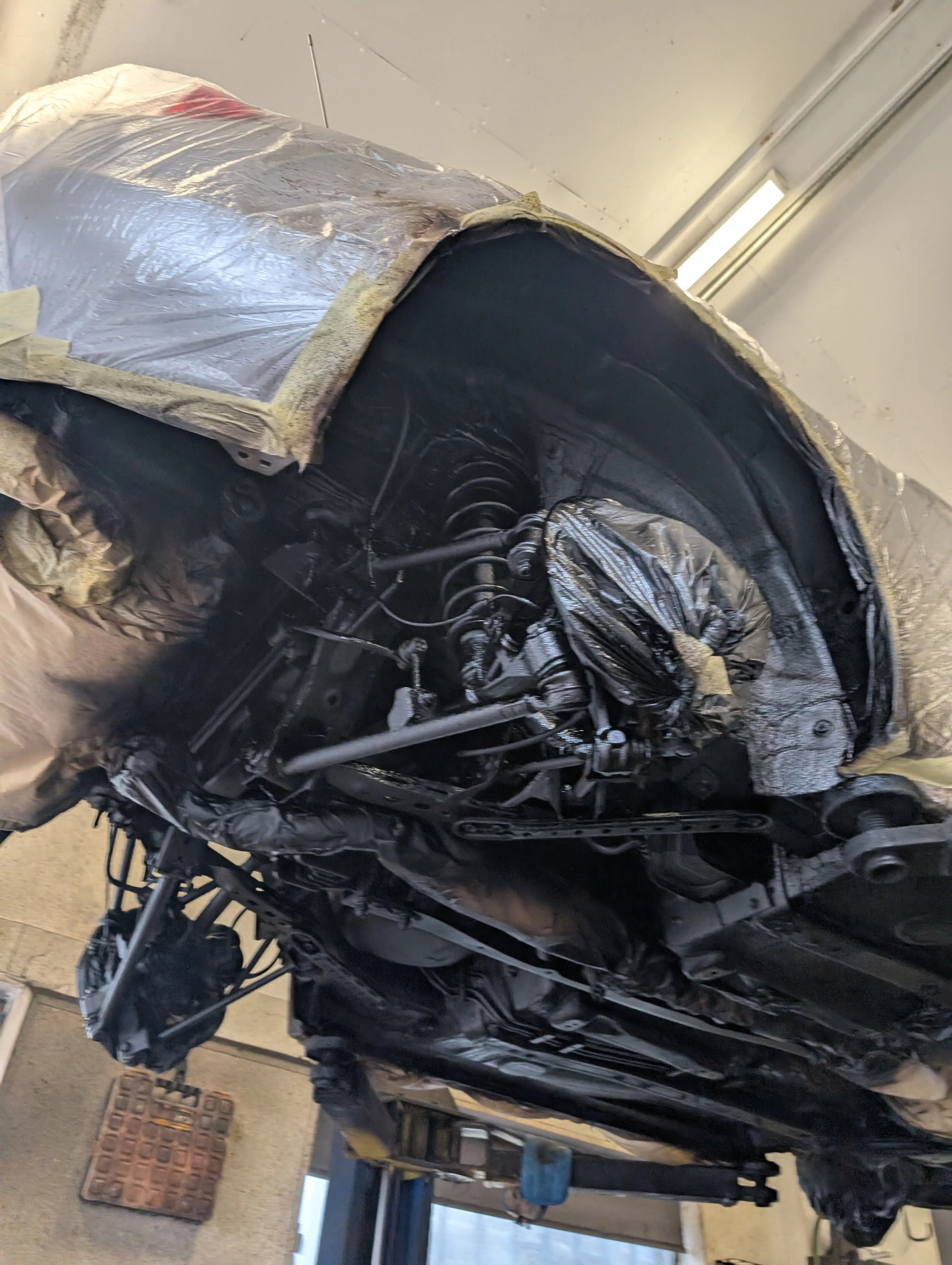
05: Internal Cavity Injection
Using specialized long-reach wands, we inject Dinitrol® cavity waxes into every box section, sill, and door pillar. This addresses the "iceberg" rust mentioned earlier.
06: External Underbody Coating
Finally, a robust, high-build underbody wax is applied. We use products with high "creep" characteristics, meaning the wax remains slightly flexible and can "self-heal" if hit by a stone chip, and it continues to migrate into seams and joints over time.
Why Professional Prep Matters
The difference between a DIY job and a Rustec treatment lies in the preparation. When you see our technicians at work in our Swansea or Newport facilities, you’ll notice the precision. We treat your vehicle as if it were in a laboratory.
Proper masking ensures that moving parts like steering racks and suspension bushings remain clean and functional. If a "quick-fit" centre sprays your rubber bushings with the wrong product, they can swell and perish, leading to a failed MOT for a completely different reason. Our process is designed to protect your pride and joy without compromising its mechanical health.
Feature | Cheap/DIY "Quick Spray" | Rustec Elite Standard |
Preparation Time | 1–2 Hours | 72 Hours |
Cleaning | None or Cold Pressure Wash | Deep Steam Clean & Forced Dry |
Masking | Minimal | Full Mechanical & Body Masking |
Cavity Coverage | None (External only) | Full Internal Cavity Injection |
Longevity | 6–12 Months | Multi-year Protection |
Risk | High (Traps moisture) | Low (Breathable, creeping waxes) |
The Value of Long-Term Protection
Whether you have a brand-new 4x4, a cherished classic, or a hard-working van, the goal is the same: longevity. Vehicles treated with the Rustec Elite Standard receive an official treatment service booklet, which acts as a powerful tool when it comes time to sell. It proves to a potential buyer that the vehicle has been cared for at a professional level, often allowing the seller to command a premium price.
If you are noticing the first signs of orange on your chassis, or if your vehicle is approaching its fourth birthday, now is the time to act. Delaying even one more winter can be the difference between a £600-£800 preservation treatment and a £2,000 welding bill.
Frequently Asked Questions
Is it worth rustproofing a car that already has some rust? Yes, provided the rust is still "surface" corrosion. Our process involves treating the existing oxidation with chemical converters before sealing it. However, if the metal is already "holed" or paper-thin, we will recommend professional welding before treatment.
How long does a Rustec treatment last? While UK roads are harsh, a high-quality Dinitrol® treatment applied via our 72-hour process typically provides robust protection for several years. We recommend a complimentary top-up service check every 12-24 months to ensure the coating remains intact.
Will rustproofing affect my manufacturer's warranty? In most cases, no. Our treatment is non-invasive and protects the vehicle's structure. However, we always recommend checking your specific warranty terms. Most owners find that the benefits of preventing structural rot far outweigh any theoretical warranty concerns.
Can I just use Lanoguard instead? Lanoguard is a popular DIY product and is excellent for short-term protection. However, for long-term structural preservation, especially in high-wear areas like wheel arches, a multi-layer Dinitrol® system offers significantly higher durability and resistance to road debris. You can read more about Dinitrol vs Lanoguard here.
If you want to protect your vehicle properly : not just cover it up : the best time to act is before corrosion progresses. You can book a free inspection or request a quote here.
Comments