
7 Mistakes You’re Making with Car Underbody Protection (And How to Fix Them)
Meta Title: 7 Mistakes You’re Making with Car Underbody Protection | Rustec Meta Description: Avoid costly errors in car underbody protection. Learn why DIY and quick services fail and how the Rustec Elite Standard prevents corrosion for good. URL Slug: mistakes-car-underbody-protection
Most vehicle owners fail at underbody protection by spraying over dirt, trapping moisture, or ignoring internal cavities. These mistakes do not just fail to protect; they often accelerate corrosion by sealing in the very elements that cause metal to fail. Effective underbody protection requires a meticulous 72-hour process, including industrial-grade cleaning, full dehumidification, and internal cavity injection, to ensure the chassis is preserved rather than buried.
Visual Mental Model: The House Paint Analogy
Proper rustproofing is like painting a house: the preparation matters as much as the coating. If you apply high-quality paint over rotten wood, the rot continues to spread unseen beneath the surface until the structure fails. Similarly, applying underseal over dirt or existing corrosion simply masks a terminal problem. To save the structure, you must treat the substrate first.
1. Spraying Over Dirt and Road Salt
The most common mistake is applying a protective layer over a chassis that hasn't been deep-cleaned. Dirt and road salt are hygroscopic; they pull moisture from the air. When you spray a coating over them, you create a "salt sandwich." The coating prevents the salt from being washed away but allows it to continue eating into the steel.
The Fix: You must perform a high-pressure, underside-specific wash using professional degreasers. Every crevice, ledge, and box section must be cleared of debris before any product touches the metal.
2. Trapping Moisture (The "Damp Trap")
Applying underseal to a vehicle that is "dry to the touch" but still holds moisture in its seams is a recipe for disaster. A poor rustproofing job can be worse than doing nothing, as it traps moisture and accelerates corrosion. In the UK’s humid climate, moisture lingers in overlapping joints and chassis rails for days.
The Fix: Professional facilities use industrial heaters and dehumidifiers. At Rustec, our Elite Standard includes a dedicated drying phase to ensure the substrate is bone-dry. Never apply coatings in a standard driveway environment during the winter months.

3. Ignoring the "Iceberg" (Internal Cavities)
Most owners focus on what they can see. However, chassis rails, sills, and pillars rust from the inside out. By the time you see a bubble on the exterior, the internal structure is often already compromised. Relying solely on an external underbody spray is like wearing a raincoat but leaving your boots full of water.
The Fix: You must use cavity wax injection. This involves using specialized long-reach probes to fog the internal sections of the chassis with high-creep waxes that displace moisture and seal the internal steel.
4. Using "Hard" Bitumen Coatings
Old-fashioned bitumen-based "shutze" products eventually dry out and crack. Once a crack forms, water is drawn in via capillary action and gets trapped against the steel. Because the coating is hard, you won't see the rust until the coating flakes off, usually bringing a chunk of the chassis with it.
The Fix: Use modern, self-healing wax or oil-based polymers. These remain flexible and can "creep" back into small stone chips or scratches, maintaining a permanent airtight seal. Understanding the best rustproofing method for UK vehicles means choosing materials that adapt to temperature swings and road vibration.
5. Failing to Treat Existing Corrosion
Spraying a barrier over active rust does not stop it. Rust contains oxygen and moisture at a molecular level. Without a chemical converter or a high-performance inhibitor to neutralize the oxidation, the corrosion will continue to expand, eventually pushing the new coating off.
The Fix: Mechanically remove loose scale and apply a professional-grade rust converter to stable surfaces. This turns the iron oxide into a stable, inert layer that can then be sealed.
6. Poor Masking and Overspray
DIY attempts often result in coating the exhaust, brake discs, sensors, and rubber bushings. This is not just messy; it is dangerous. Bitumen on an exhaust creates a fire hazard, while oil-based products can degrade certain rubber suspension components.
The Fix: Meticulous masking is mandatory. Every component that should not be coated, including the braking system and heat shields, must be wrapped.
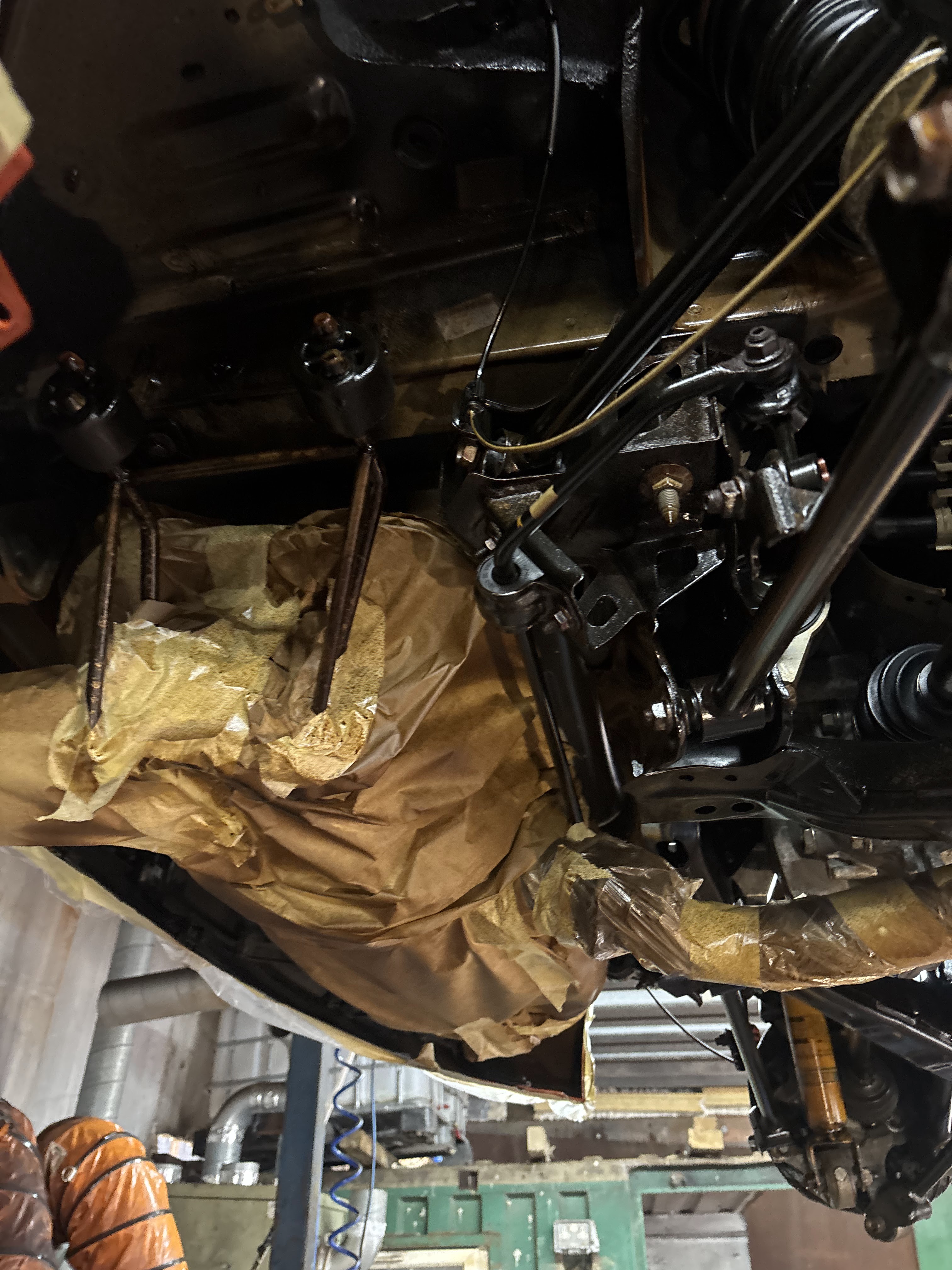
7. The "Wait and See" Approach
The biggest mistake is waiting until rust becomes visible. Many owners believe that if the car looks clean from the side, the underside is fine. In UK conditions, corrosion is not a possibility , it is an inevitability without proper protection. Waiting for a "reason" to rustproof usually means you are already paying for repairs rather than prevention.
Ownership Identity: The Proactive Guardian
The most successful vehicle owners, those who keep their Defenders, Transits, or classic cars for decades, understand that the chassis is the life of the vehicle. They don't view rustproofing as a cosmetic upgrade; they view it as structural insurance. By protecting the vehicle early, they avoid the heartbreak of an MOT failure and the massive expense of structural welding. These owners know that doing nothing leads to financial loss.
UK-Specific Context: The Perfect Storm
The UK presents a unique challenge for vehicle longevity. Our winters involve heavy salting of the roads, which creates a highly corrosive brine. Combined with high humidity and frequent rain, the underside of your car is essentially sitting in a salt bath for six months of the year. This environment makes professional-grade protection a necessity rather than an option. Failing to account for this is why so many imported vehicles from drier climates perish within three years of arriving on UK shores.
Financial Consequence: Prevention vs. Cure
The numbers do not lie. Investing in professional protection is a fraction of the cost of structural restoration.
Professional Rustproofing: £500 – £1,200 (Typically)
Structural Welding/Patching: £1,000 – £4,000+
Resale Value Loss: £2,000 – £5,000 (A rusty frame is the #1 dealbreaker for buyers)
Replacement Vehicle: £15,000 – £60,000+
When you consider the cost of rustproofing in the UK, it is clear that the "expensive" option is actually doing nothing.
WHEN TO ACT: The Protection Window
0–3 Years: The Prevention Window. This is the ideal time to act. The metal is pristine, and the how long rustproofing lasts in the UK is significantly extended when applied to a clean factory base.
3–5 Years: The Correction Window. Surface corrosion is likely starting in the seams. Immediate action is required to halt progression.
5+ Years: The Urgent Window. Most UK vehicles of this age have established corrosion. You are no longer just protecting; you are performing "damage limitation."
Visible Rust: The Emergency Window. If you can see it, it is already deep. Action is required now to prevent the vehicle from becoming scrap.
Comparison: Rustec vs. The "Quick Spray"
Feature | Quick "Drive-In" Service | Rustec Elite 72-Hour Standard |
Duration | 2–4 Hours | 3 Days (72 Hours) |
Preparation | Basic jet wash | Industrial deep clean & degrease |
Drying | Air dry (often still damp) | Controlled dehumidification |
Masking | Minimal to none | Full component masking |
Cavities | Often ignored | Full internal wax injection |
Outcome | Temporary "black" look | Long-term structural preservation |
The Rustec Elite 72-Hour Standard
Process matters more than product. Our elite process is designed to eliminate the 7 mistakes mentioned above:
Stage 1: Industrial Cleaning: We remove every trace of road salt and debris.
Stage 2: Dehumidification: The vehicle is dried in a controlled environment to ensure no moisture is trapped.
Stage 3: Masking: We protect the brakes, exhaust, and sensitive sensors.
Stage 4: Treatment: We apply high-performance converters to any surface rust followed by premium cavity waxes and underbody polymers.
Buyer Psychology: Avoiding the "Regret Trap"
Most customers call us only after their car has failed its first MOT due to corrosion. The conversation always starts with: "I wish I did this sooner." Don't let your vehicle become a statistic. Can rust cause MOT failure? Absolutely, and it is the most common reason for older vehicles being removed from the road permanently. Acting now removes the stress of the "MOT dread" and ensures your investment is secure.
FAQ
Does rustproofing increase resale value? Yes. A documented professional rustproofing treatment is a major selling point in the UK. Savvy buyers specifically look for protected chassis, often paying a premium of £1,000–£2,000 over a neglected equivalent. Indeed, does rustproofing increase resale value is one of the most common questions we receive, and the answer is consistently reflected in the used car market.
Can I just do it myself with a few aerosol cans? You can, but you will likely commit mistakes 1, 2, 3, and 6. Without a lift, industrial heaters, and specialized cavity probes, a DIY job is almost always superficial and often traps moisture, doing more harm than good.
How often should it be reapplied? A professional treatment typically lasts 3–5 years depending on mileage and usage. We recommend an annual inspection to touch up any areas affected by heavy stone chips or grounding.
Is it worth rustproofing an older car? Yes, provided the chassis is still structurally sound. Stopping existing rust is better than letting it finish the job. If you plan to keep the car for more than two years, it is a financially sound decision.
Rust doesn’t wait until it becomes visible. By the time most owners notice a problem, the damage underneath has already started costing them money. Waiting feels cheaper in the short term : but it nearly always becomes more expensive later.
👉 Book your inspection now [https://calendly.com/rustec-works/free-vehicle-inspectioni] and protect your vehicle before corrosion takes hold.
Link to 3 existing relevant Rustec blog posts:
Comments